
🌸 Soul Swa Mandala
Your Soul’s Own Sacred Circle • A Soulroutes offering
Your Soul’s Own Sacred Circle • A Soulroutes offering
Every soul carries a circle within it.
A space where wisdom, memory, and dharma gather.
That circle is your Swa Mandala — your own sacred field of becoming.
Here, ancient Vedic wisdom meets lived experience. Not as borrowed philosophy. Not as dry ritual. But as threads of remembrance you can actually live.
Soul Swa Mandala is the home of all Soulroutes journeys — a mandala where each course, reflection, and practice becomes a petal in your circle of truth.
Each course is a petal of the circle. Together, they form your Soul Swa Mandala.



The seeds of Soul Swa Mandala were planted in the early 1980s, when young Komal would drift to sleep with bedtime stories from the Purana.
Not just tales, but transmissions. Each deity became an archetype — to soar with, to engage, to explore, to invoke. Every symbol spoke not of religion, but of resonance.
Years later, life brought her to Mehul — a seeker steeped in tradition, rituals, and parampara. Where Komal carried the fire of archetypal awakening, Mehul held the grounding of ritualistic structure.
When the two merged in marriage, something new was born: the embodied ethos of Hinduism flowing through Komal wove itself into Mehul’s devotion to order, practice, and parampara.
Together, along with their other partners Anjli Baxi, Aarya Chhatbar, and Sanjay Menon, Komal & Mehul became Soulroutes.
And unknown to everyone else, the Soul Swa Mandala itself was being forged — its seed igniting with the birth of their daughter, Aarya.
Soul Swa Mandala is not a name. It is a field that has been growing for decades. A field that is now ready to hold you too.
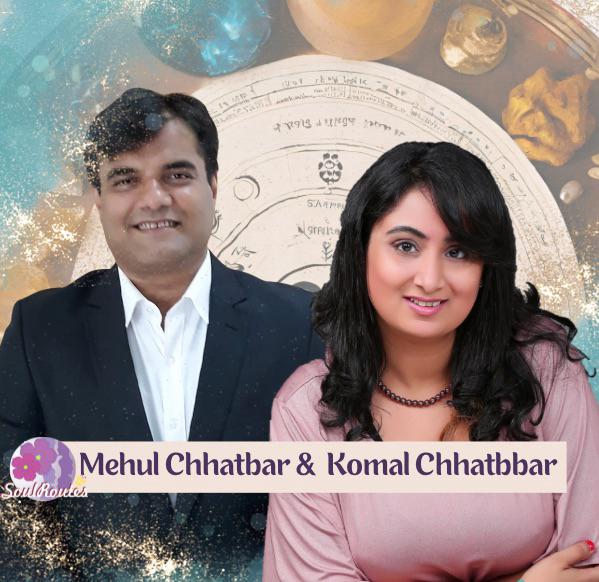
Komal Chhatbbar The Architect of Inner Revolutions Consciousness coach, Hypnotherapist, life coach Yoga Trainer, cosmic oracle & occultist. She embodies alignment — decoding karmic imprints and mapping them into soulful systems. Strategist, creator, alchemist — she transforms trauma into thriving. Co-founder of SoulRoutes, she lives her work as ritual: fierce, fluid, and deeply felt.
Mehul: The Master of Cosmic Strategy JyotishshastrAcharya, qualified lawyer, certified interior designer, and permaculturist. A pioneer in psych-astrological reading, he aligns destiny with decision. As counselor and business coach, he builds sustainable systems of clarity, efficiency, and growth. Visionary co-creator of SoulRoutes, he bridges stars with structure.
Together, they hold Soul Swa Mandala as a sacred archive and circle of offerings — a living hub for anyone walking their swa dharma.
A quiet, conceptual space held during the sacred month of Shravan. These are reflections, not teachings; explorations, not conclusions.
Vidyeshwar Samhita.
This morning, as I sat with a shloka from the Vidyeshwar Samhita, I recognised the realisation.
Shiva says—“I entrust Creation to Brahma, Preservation to Vishnu, Destruction and Concealment to Rudra and Mahesh. But Anugraha—the power of Moksha—I retain for Myself.”
At first glance, it looks like Shiva is assigning roles—divine departments of cosmic function. Yet the deeper I sat with it, the more I recognised: Shiva isn’t acting like a god holding something back. Shiva is not a being with more privilege. Shiva is the realisation itself—the pure, non-individuated awareness that never entered the field of doing.
Creation plays out through Brahma. Preservation through Vishnu. Dissolution and concealment through Rudra and Mahesh. All of these are sacred movements within Maya—within the game, within time and causation.
Anugraha… Grace… it isn’t an action. It’s not a reward, not an event, not a function. It’s the undoing in all doing. The space that becomes visible after everything else has run its course. After the identity has tried, sustained, collapsed, and hidden from itself. It reveals to itself.
It’s not about understanding effort. It’s about the exhaustion of all effort. Not about achievement. It’s about acceptance. Not about reaching somewhere—but acknowledging what was never not there.
None of the deities are denied this because they are lesser. They simply represent movement, individuation, expression. And Anugraha cannot be given to form. It only arises in the absence of it.
So today I see more clearly: Shiva doesn’t give moksha. Shiva is moksha. Not a god among gods—but the effortless spaciousness that remains when the need to become drops. The awareness that neither creates, sustains, destroys nor hides. But simply is.
Maybe today is the day to stop striving and just be. What is as is.
Vidyeshwar Samhita.
Today’s reading took me down a nostalgic, sweet memory lane.
My first memory of vibhuti goes far beyond my understanding of God. Or Shiv. To me, Vibhuti was something my grandfather used to keep—this small, red round plastic box with a white lid right beside his bed. Anytime we hurt ourselves—whether it was a fall, a heartbreak, or tears we couldn’t explain—he’d gently apply the vibhuti on that part or on our forehead or shoulder and say, “everything will be fine.”
At that time, I thought it was just his way of soothing. And maybe it was. But it worked. And now I see why.
We often think of vibhuti—the soot left after things are gone, something connected to cremation, to death. And yet Shiv Purana doesn’t treat it as a symbol of death. It treats it as a precondition for spiritual life.
Vibhuti here is sooo much more than soot. When applied with awareness, it’s a sacred eraser—releasing our energetic blocks of stored trauma, helping the body reintegrate what got frozen or fragmented.
According to Shiv Purana, there are two kinds of bhasma: Mahābhasma (from yajnas and fire rituals) and Svalpabhasma (from domestic, everyday sacred fires). Some of you who joined last year’s Mahashivratri night ritual with us may remember receiving a rudraksha bead and sacred ash. That was Mahabhasma—created through hours of japa, yajna, mantra, and presence.
What makes any bhasma sacred isn’t just what it’s made of… It’s also how it’s made. The intention. The vibration. The surrender. The fire it’s offered to. The mantras chanted. The feeling with which the ash is created is what gives it life.
Only bhasma that’s been energized through Vedic purification qualifies to be applied as Tripundra—the three horizontal lines across the forehead. And these lines are not for aesthetic. They mark the dissolution of the three gunas—Tamas, Rajas, and Sattva—burned down in the fire of Jnana. (Not book knowledge—but lived, internal awareness.)
It’s an invocation to the “you” that existed before the idea of “you” began… Vibhuti is what remains after ego has burned. That’s why it’s applied before mantra, before japa, before dhyana. Because only what’s become ash is ready to experience the fire of tap.
Even the way we apply Tripundra matters… using the middle finger and ring finger—drawn outward across the forehead. Then, using the index finger, we draw the final line underneath the first two. Why? Because once Rajas and Tamas are burned off, even Sattva—the last, most refined mask of ego—needs to be offered. Only then can sadhana begin.
Today, I’m sitting with that. May we walk in the resonance of what we’ve already burned of our superfluous personality. Shivoham.
Shiva Purana – Vidyeshwar Samhita.
There’s something quietly radical about today’s reading.
In Kali Yuga—the age of distraction, distortion, and decay—Shiv Purana says that even a Parthiva Linga made of simple mud or clay, when worshipped with bhava and no agenda, gives more punya than intense tapas, yajnas, or even scriptural study.
Not because the clay is magical. Not because the ritual is fancy. But because in this Yuga, accessibility is grace.
We’re wired to chase the big, the rare, the permanent. But here, Shiva flips it: The most “temporary” Linga, made with your hands and placed with devotion, becomes the fastest route to Him.
And yet… most of us overlook this. Because clay feels lesser. We think—“How can something that dissolves by evening carry any spiritual weight?” But Shiva says the opposite.
Because what is mud, really? It is earth—our body. It is shaped by intention—our bhava. And it returns to nothingness—just like all of us.
The Parthiva Linga is a living Upanishad in form. It tells us: You don’t need permanence to touch the Eternal; You don’t need grandeur to be heard; You don’t need expertise to offer love.
One handful of earth + One clear sankalpa + One act of offering = More powerful than months of mechanical tapasya.
In the mud, we meet the most direct mirror of Shiv: The form that dissolves, and yet delivers.
Maybe this is the real gift of Parthiva Shiva Puja—that it lowers the threshold for liberation, and raises the value of real bhava.
Earth. Bhava. Nishkam Bhakti. That’s the map. No shortcuts. No hierarchy. If you have nothing but a pinch of mud and an honest heart—that’s enough. More than enough. Shivoham.
A beautiful way to meditate—one that doesn’t rely on technique, breath, or posture—is to sit with a question. But not a question about you. A question for Shiv.
Not “What should I do?” but: “What are You?” • “What do You long for?” • “What does surrender feel like, in You?” Ask something that pierces through the personal. Then sit with it.
Not like you’re waiting for an answer but like you are Shiv, and something ancient in you already knows. Let it unfold. Let it speak. Let it reach places in you that you didn’t know were waiting.
Because sometimes, it’s not in asking for something that we receive. It’s in becoming the one who could answer. Shivoham.
Vidyeshwar Samhita.
Shiv Purana says chanting OM 9 crore times purifies the self—and another 9 crore times allows mastery over elemental forces like Akash, earth, fire, air, and water.
At first, it sounds like spiritual exaggeration. But it’s not poetic. It’s precise. It’s vibration technology. In quantum theory, everything is vibrational. Matter isn’t solid. It’s frequency. Our body, emotions, even thoughts — fields of subtle, moving energy.
OM, as the primordial sound, isn’t just sacred—it’s a carrier frequency. Repeating it that many times isn’t ritual—it’s entrainment. You align your scattered inner waves to a coherent base vibration. That’s what the Purana calls purification.
The first 9 crore chants reorganise you. The second 9 crore tune you into the elements themselves… This is what Shaiva Tantra calls Bhuta Siddhi. You’re not “controlling” matter. You’re resonating with it.
And yet… You can’t fake the bhava behind a crore chants. Something in you has to melt to keep going that far. What if OM is not something we chant to reach Shiva… but the sound we become when our ego has dissolved enough to finally match His frequency? Shivoham.
Naag Panchami Reflection · Vasuki & the Silent Mastery of Shiva.
Vasuki Nāg. The serpent Shiva wears—not to conquer, not to cast away—but to keep close.
This isn’t just a symbol of power or danger tamed. It’s the story of what Shiva is willing to live with, without needing to fix it. Vasuki once writhed in pain during the churning of the ocean—Samudra Manthan… and Shiva, the one who drinks what others cannot handle, made that same serpent his companion.
Vasuki is a mirror: the knot in the spine (granthi) that awakens when you stop resisting; the kundalini coiled at the base; the ego transformed, not erased—worn gently, wisely; the instinct that no longer needs to strike; the fire held at the Vishuddha—where poison becomes wisdom.
Shiva doesn’t slay the serpent. He holds it. Right where voice, truth, and toxicity meet… Not everything fearful / powerful / discomforting needs to be removed. Sometimes, true mastery is not transcendence. It’s containment with presence. Shivoham.
Rudra Saṃhitā.
Gunanidhi, a gambler-thief, becomes Kubera, the divine treasurer of the gods—not through austerity, but through one choiceless act: lighting a lamp before Shiva.
Even though he lived unethically, he carried full presence in his actions. His mind and body were congruent—even in theft—and in that single moment, that integrity directed toward Shiv changed everything. Shiva doesn’t wait for perfection. He responds to alignments.
Think—if one unintended gesture—held in attention—can be enough… how many opportunities we have to explore this alignment every day? Shivoham.
Vidyeśvara Saṃhitā.
We often wear Rudraksha like a spiritual accessory. Often bypassing the opportunity to bask in its pulse. Shiv Puran says these beads were born from the after-drop of aeons-long tapasya. A meditation so profound that when Shiva finally opened his eyes, his entire system—consciousness, body, prana—released what could not be held. That tear hit the earth. That tear, crystallized frequency, became Rudraksha.
Rudraksha is a bio-responsive seed… More than mechanics, it’s the field it remembers. Each bead is like a piezoelectric shell—its surface holds vibratory memory… When we wear Rudraksha, we don’t wear a religion. We wear a frequency recorder. The seed that never stopped transmitting. Shivoham.
This story has stayed with me for years… Brahma and Vishnu behold an endless pillar of light—Shiva as Linga. Vishnu returns honest. Brahma lies, with Ketaki as accomplice. The lie costs them both: no temples for Brahma, Ketaki banned from ritual.
Truth isn’t just about telling facts. It’s the energetic alignment between word, intention, and soul. In the realm of Shiva, no rank, role, or ritual saves you from the cost of misalignment. Only truth carries you through. Shivoham.
Rudra Saṁhitā.
“AUM is not sound. AUM is a being. AUM is The Shabda Purusha.” • Brahma is A, Vishnu is U, Shiva is M — not just a syllable, but the bindu, the drop of silence that holds everything and nothing at once.
And maybe that’s where the four vāks come alive: Vaikharī (spoken), Madhyamā (inner voice), Pashyantī (felt seeing), Parā (the silence after the last hum). Not what you chant. Not what you hear. But what remains after all vibration rests. Shivoham.